

NOTE: David is out of town dealing with a family emergency, so Jason Hagerty (a guest on Episode 012 of the show) is filling in this week.
Let me start off by saying that I didn’t get around to playing the first Mass Effect until quite some time after it was released. I’d seen promos here and there, of course, but at the time I wasn’t a huge Xbox fan and nothing about the game’s advertisements really drew me in. A nondescript male space marine saves the galaxy from alien invaders — tell me if you’ve heard THAT one before. But eventually, after being told how good it was time and time again by people who HAD played it, I saddled up and bought the Game of the Year edition.
Thank God I did.
While I wouldn’t go so far as to say that playing Mass Effect was a “life changing” experience, I’d definitely say it’s one of the most defining games of my lifetime. Now don’t get me wrong, the game is by no means perfect; but the combination of RPG elements, third person shooter combat, and a thrilling story line about the first human Specter (think U.S. Marshal, but in space) drew me into a universe that I would gladly go back to over and over again.
If you haven’t played the games yet, consider this a piece on why you should. Only, I’m not going to focus on gameplay or graphics or any of that stuff…that’s what reviews are for. I’m going to focus on the strength of the setting itself, and why the Mass Effect Universe is one of the strongest Intellectual Properties of our time.
First off, let’s talk about the two “major” settings for science fiction out there: Star Wars and Star Trek.
In Star Wars you’ve got a grand, mystical, and almost fantastical setting whose characters and places are almost interchangeable with a typical fantasy setting. The planets in Star Wars are seldomly uninhabitable, as it seems almost every other rock floating in space has managed to bear life regardless of its natural recourses.
And while the various shapes and sizes of alien creatures in Star Wars has always been one of its strong suits (take the Cantina scene from A New Hope, for example. To this day it is one of the best examples of how a movie can inspire us to wonder what kind of weird things live out there amongst the stars), there comes a 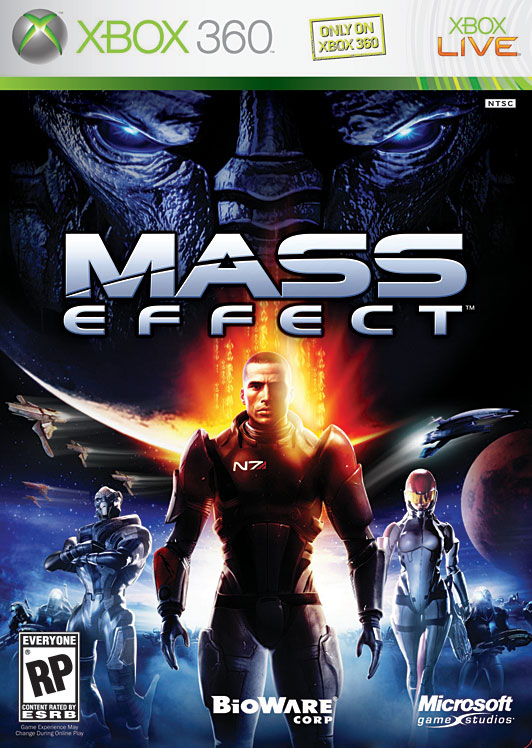 point where you almost have to wonder exactly HOW all these creatures can eat the same food, speak the same language, and breath the same air.
Star Wars is the kind of place where a bunch of dudes in robes can show up with laser swords and fight dragons in a desert wasteland before jumping in their spaceships and then dogfighting an army of robots in an asteroid field. It’s fun, it’s sci-fi, but I think we can all admit that it lacks a certain realistic edge to it.
Now let’s take a look at Star Trek. Here is a universe where mankind and its allies cruise around in warships exploring the galaxy and trying their best to make friends and keep the peace. It’s a more political setting, where moral and ethical issues can be mixed with pirate ship battles on the holodeck and all-out space battles with the Borg.
It’s a versatile setting, but it is so often limited by the restraints of its past. The uniforms, the weapons, and aliens…very rarely do they seem all that “real.” More often than not they look exactly like what they are: extras and props on a television show. The on-planet locations look like different locations on Earth, the weapons look like TV remotes or toy guns, and the computer screens look like a colorful picture that some actor is just pushing pretend buttons on.
Likewise, the alien races of Star Trek tends to suffer from the “humans with make-up on” syndrome. You know what I mean: the old, “Oh look, we all magically have the same bodies just different heads!” shtick. And while I will fully admit that the newer Star Trek movie did wonders to change some of these shortcomings, their legacy will more than likely never (and arguably SHOULD never) leave the franchise.
Let’s be clear, I’m a fan of both settings. In fact, you’d be hard-pressed to find a science fiction setting I don’t like. But sometimes you feel like there’s something missing, something that helps fill the holes the other two don’t touch on…
This brings us to Mass Effect.
As you’ve probably guessed, the Mass Effect Universe is one based so readily in fact that at times you almost wish they did more with it than they did. It’s the kind of universe where more than half the solar systems you go to have no easily habitable planets in them. At least, not by human standards. A colony here, a colony there…sure. But major population centers? Those are few and far between. It’s almost like the wild west out there. Outside of the major cities is nothing but outlaws and dirt-bags looking to slip by the long arms of the law — oftentimes to great effect.
In the Mass Effect Universe, aliens come in all sorts of shapes and sizes (much like Star Wars) but they aren’t so numerous that you can’t keep track of how each one is different. And while each major sentient race has a basic “humanoid” shape, the similarities often 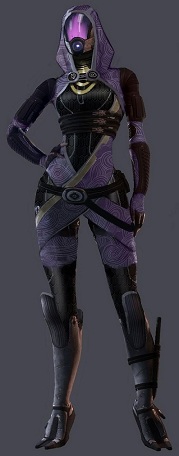 stop there. This is a setting where two species can’t even eat the same food because their bodies use different proteins than one another. It’s the kind of setting that not only creates a race that cannot breath an Earth-like atmosphere, but can have them sitting beside a race that possesses no mouth/eyes/ears/nose and have the two arguing politics over a cup of tea.
Mass Effect embraces the differences that each alien species has without making them feel like stereotypes. Take for example the character Tali’zorah, a member of the quarian race who becomes a companion to the main character of the series. As a quarian, Tali’s immune system has long since become next to useless after her race was forced to leave their planet and travel the stars as nomads of a sort. At no point does the player ever see what Tali looks like under the tinted mask of her air-tight environmental suit. Yet not only is Tali one of the most loved characters in the game, but she even became a love interest in the second game after Bioware (the company that makes the Mass Effect series) saw how much the fans loved her. Tali’s suit and her people’s struggle to return to their home-world could have easily become stereotypical facts that would have dragged the character down, but instead they become footnotes in the background for an engaging and loveable character.
But as we all know, while strong characters can certainly help keep a setting afloat, it’s the world you put them in that really fleshes them out. Bioware didn’t slack there either.
Now admittedly, the bulk of “sci-fi” technology in Mass Effect relies on “mass effect field” (gravity controlling technology we reverse engineered from alien artifacts) to work, the principles behind them are all based in the most cutting-edge technologies of our time. Where other settings use lasers (which are actually just burning gas and not light) or phasers (which fire a fictional type of energy), Mass Effect settles on plain old mass accelerators (AKA rain guns) to gun down their opponents. Even faster-than-light communication is explained in terms we can at least grasp with our current knowledge of the universe around us (see: quantum entanglement). And while there is certainly a number of liberties taken with all this material — it is science fiction after all — Bioware seems to have done its research and tried its best to bring as accurate a portrayal of our potential future amongst the stars as it could.
And all of this is done in such a way that you, the player of the games, can ignore it or absorb it as much as you want. Want a guy throwing tables across the room like a Jedi? It could be space magic, or it could be the implanted mass effect field generators in his body that allow him to manipulate gravity on a micro-scale to “pick up” the table and move it across the room. Either way, the characters around you will act as though it’s par for the course and let you, the player, decide how much you care.
One of my favorite sequences happens as you enter one of the major population hubs of the galaxy. You walk past a group of newbie space pilots getting a crash course from their commanding officer on just how cruel physics can be…
http://www.youtube.com/watch?v=p77XnhzJz7g
On the one hand the scene is humorous and entertaining. On the other it’s highly educational on both what we currently understand of physics, and how that understanding actually translates into reality when you start dogfighting in space. Sure, flying in circles and spewing laser fire at Tie Fighters in a Star Wars game is fun. But you have to hand it to a setting that can set stuff like that aside for the sake of realism. Of course the Mass Effect games don’t focus on space combat like some other games have, so that certainly helps. But what space combat is seen in the games still manages to be exciting and entertaining without devolving into a wild laser-spewing firefight.
The Mass Effect Universe is the kind of place you could picture your great great great grandchildren living in. A place filled with science that we’re starting to see now, but also filled with the kind of mystery and excitement that we can never have. It’s where you can match wits with a rogue A.I. in the morning, then swing by an alien strip joint in the evening for a bachelor party. It’s a place where the day-to-day dramas of the world aren’t ignored or set aside just because it’s the future. Everything is still pretty much the same, just different. It’s rateable. It’s a universe that feels attainable, instead of feeling fictional. And it’s exactly what we’ve been missing out on all these years.
Of course I could go on and on about what separates Mass Effect from its fellow science fiction counterparts, but if I did, we’d be here all day (and I doubt any of you’d be having any fun by that point). Hopefully I’ve provided you with enough reason to at least give the games a shot (if you haven’t already), or at the very least given you a reason to watch someone else play them if you get the chance. And hopefully you’ve come away from this with a new appreciation for the amount of effort game designers like Bioware put into the settings of their games.
After all, although it may not always seem like it, sometimes the biggest character in a story isn’t the protagonist him/herself, but the world that they live in.

 Gray Areas