

This column originally ran on November 19, 2009.
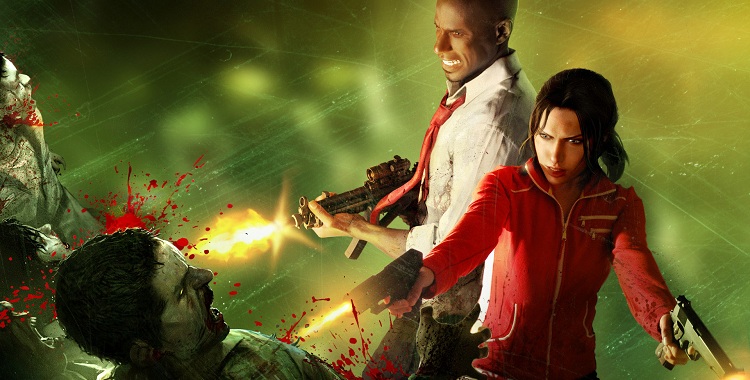
With the recent release of Left 4 Dead 2, we have found our time split. Sure, reviewing some of the biggest titles in gaming history is important, but so is surviving the day of zombies. In between killing infected clowns and stealing stock cars, Checkpoint takes a look back at the original L4D to see what got this cooperative revolution started, and debates whether Bill or Francis was more useless.
Apocalypse Now
Lee: We should talk about the concept. Left 4 Dead brought the zombie apocalypse to the forefront. Games like Dead Rising and Zombies Ate My Neighbors were good, but they didn’t deliver the survival experience this game put forth.
Shaun: I agree. Those titles didn’t really utilize the whole “survivors against the world” concept.
Jason: Left 4 Dead really puts you in the shoes of a bunch of average folks just trying not to get killed.
Chris: I’m a much bigger fan of average folks than photojournalists who have covered wars, you know.
Shaun: Probably my favorite aspect of the game was the forced reliance on teamwork. If you lone gun it in L4D, you die. It’s that simple.
Chris: Exactly. It’s hard enough to manage the onslaught when somebody strays even a few feet away, let alone half the level.
Jason: Left 4 Dead is a true cooperative experience. As in, without the cooperation of your friends, you won’t make it to the safe room.
Lee: There really is no chance to run off and do it on your own. Even if your friends are dead and you have to make it to a closet, it is a pain.
Shaun: Yeah, a Hunter will rip your face off, or a Smoker will snag you. Of course, when I stayed with the group, Lee just shot my character in the face. Bill is ugly and old, but he’s not a zombie!
Lee: He was after I got through with him.
Chris: Nothing kills Bill quite like a shotgun to the face. Or some sort of exploding heart technique.
Lee: What weapons did you guys use primarily?
Shaun: I liked the shotgun. Not as elegant as the rifles, but I just didn’t think they were effective enough.
Jason: Yeah, I preferred the auto-shotty. Close range, rapid fire, large spray. Perfect for killing hordes and not too bad in a pinch against a tank. After that were the pistols of course. Unlimited ammo? Yes, please.
Chris: It was shotgun for me, because I equate “shotgun” with “unending zombie apocalypse.” I used that enough to where I could even kill distant things somewhat effectively. Occasionally I’d pick up the sniper rifle, but not much. And boy, could I rapid-fire those pistols.
Lee: My weapons varied depending on the difficulty. If I was on normal, I went with the hunting rifle. On advanced I took the assault rifle. Expert was always the shotgun. You need to put those zombies down fast, and Bill is probably already dead. No chance for friendly fire.
Jason: I used the shotgun at all times, all difficulties.
Chris: Most of the special infected love to get up close in Left 4 Dead, so having that kind of firepower was important to me.
Jason: On a related note, having the mix of both common mindless hordes of zombies to shoot your way through as well as the specials that force you to rethink your tactics was a stroke of genius on Valve’s part.
Chris: That genius was responsible for firmly implanting the co-op elements into the game. Divide and conquer isn’t possible here, unless you’re on Team Zombie. Then it’s extremely possible.
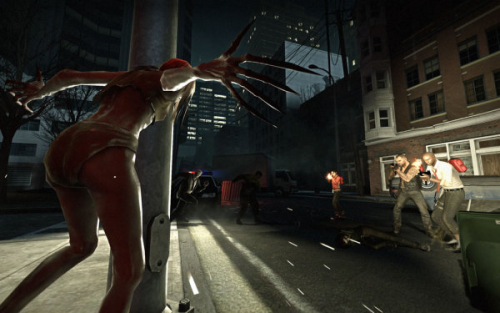
Shaun: Yeah, I really liked how the special infected changed the dynamic of the gameplay. If it were just hordes of normal infected, the game would get old pretty fast. However, when you have to hightail from a Tank midlevel, or chase after a teammate being pulled away by a freakishly long tongue, it changes the game.
Lee: Which was your guys’ least favorite Infected, besides the Tank?
Shaun: I didn’t like the Hunters. They would just come out of nowhere, and if you were even a little separated from your team, it was heartbreak hotel. I don’t know why I used that phrase.
Chris: Because you love Al McCoy. My least favorite was the Hunter as well. Personally, getting pounced wasn’t as bad as having him swing away at your face repeatedly from just outside of your melee reach. I like the hoodies, though.
Jason: I’d have to say the smoker was the one I hated the most. They had a habit of running like bitches. They forced you to hunt them down, only leading you farther and farther from your teammates.
Lee: Mine had to be the Boomer. That bastard would pull a Matrix and dodge a shotgun round, spit on me, and somehow run out of the way of my subsequent blasts. Then I have to fight off a horde and find that guy again, assuming my teammates haven’t shot him while he is standing next to me.
Jason: Each special infected is designed to mess with a different play style, so I suppose it shouldn’t be that surprising.
Lee: Yeah. My play style was survive the apocalypse. They sure messed with that plan.
Characters Welcome
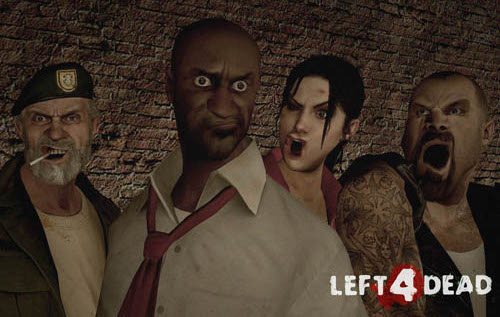
Shaun: I thought L4D did a really great job in providing depth to its cast, and what is interesting is that almost all of it stems from their banter and dialogue. There is very little back-story, so every bit of characterization that takes place is from their interactions on screen.
Lee: The characters’ personalities were a good addition. You don’t just have four people walking around in silence. They all have something to say about what is going down.
Shaun: Bill was the most badass, but a case for favorite characters can be made for each survivor. Except for Francis. No one likes him.
Lee: I’m sure Francis’ mother liked Francis before she only liked his brains.
Shaun: Maybe. Probably not.
Chris: I’m not necessarily convinced Francis’ mother was infected. I basically picture her looking like Francis with a wig, and we know Francis doesn’t go down without a fight (even if he started the fight himself).
Jason: I enjoyed Zoey the most. Her mix of sarcasm and wit really brought some humor to the group. Likewise, she was the only member to make numerous movie references, which really added a layer of lovability to her character. Because if I was in the zombie apocalypse, lord knows I’d do my best to remember every single horror movie I ever watched. Zoey seems to agree.
Lee: My favorite character was also Zoey. Is she Bill? Nope. She wouldn’t be able to shoot Bill if she was. Francis? Nope, no crotch rubbing against a Witch’s face. Louis was okay, but Zoey was a horror movie buff. And being the cliché black guy was not my style.
Shaun: Good, now we have a genital reference and racism. Good.
Lee: Says the guy who played the guy who was laid out the most.
Jason: Louis was a great “average Joe.” He was always trying to look on the bright side of things. And he never gave up hope. A good change of pace from the ever-negative Francis.
Chris: I played Louis all of the time, partly because of PILLS HERE and partly because his optimism amused me. Unfortunately, he’s by far the worst character in the intro movie.
Shaun: Hey, let’s be fair; I think the readers are getting the wrong idea here. Francis died the most. Bill is a survivor, except when Zoey shoots him in the back of the freaking head every five minutes.
Lee: Bill worked in the kitchen in Vietnam. He took shrapnel from an exploding stove.
Jason: Purple heart.
Shaun: Wha…?
Lee: Survivor my ass.
Jason: The game’s AI Director is amazing in its ability to deliver a new character-based experience every time you play. A trip up an elevator one game might get you a joke about shooting Bill’s beard, while the next playthrough may lead to Zoey making a Star Wars reference.
Lee: Even though playing as a specific person didn’t make much of a difference, just knowing your character wasn’t as mindless as the zombies he or she was fighting really helped make the experience more fun.
Jason: They’re also expressive in their interactions with the environment. See a gun? They yell it out. See a health pack? They’ll let everyone know. See a horde of zombies? Well, they’ll be sure to yell profanity at their own impending doom.
Chris: And Francis is sure to hate everything involved with his impending doom.
Shaun: Jason, you touched on the AI Director, and I think it’s worth mentioning what an important feature this plays in the game’s replay value. Rarely is a playthrough the same. Sometimes, the Director will spawn helpful things like ammo and health in random closets or bathrooms. Most of the time, it hates you, and puts things like Witches in your way, or Tanks in the most inopportune of areas.
Jason: Sometimes I enjoy turning a corner to find a Tank punching me in the face. Wait, no, that’s not true.
Lee: The Director does factor heavily into the replay. Every time, you play the same levels over and over. If it wasn’t for the variation in the play, it would be stagnant. You would be able to expect a Tank around the corner. Left 4 Dead doesn’t make things that easy on you.
Chris: And thank goodness. The Director’s ability to scale the difficulty based on how your group is doing is a huge factor in keeping together the group aspect. If you play with a new person who gets killed frequently, the game will scale back a bit. If you’re with a hardened group of ass-kickers, say goodbye to your hopes of ever finding pills.
Jason: The Director enjoys putting zombies just behind that hallway you just passed. Oh, you might have thought it was clear…but turns out there were about 50 zombies in that closet just waiting to eat your face.
Lee: And whenever we played, that damn Director would unleash an unholy wrath upon us. Just run into a Witch? Well, you snuck around her, but the Tank was there. Finally kill the Tank? You just startled the Witch. Down the Witch? You get a horde, and another Witch, and five Boomers. No, there will be no health packs, or pills, or ammo. Fight with your pistols.
Chris: Not to mention those times when there was a Tank in the safe room. Or 3,000 Witches.
Shaun: Things like this made me hate the director, but honestly, these situations made me enjoy the game so much more. It was visceral every time.
Jason: Thank god for human sacrifices — err, Francis.
Campaign Promise
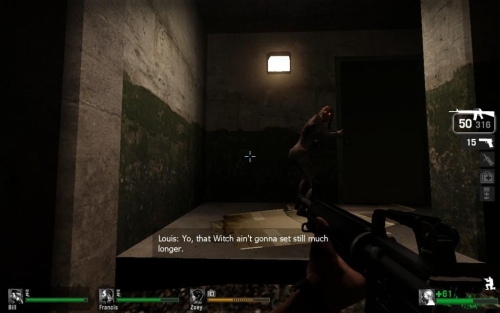
Shaun: While there were only four relatively short campaigns to choose from (five including the DLC Crash Course), each campaign is fairly unique from one another, and has their own special segments. In Dead Air, you have to drive a van through a barricade, which sets off a huge horde. In Blood Harvest, the survivors have to make their way through a cornfield, in what is possibly the most despised sequence in the game.
Lee: The crescendo events did give us a chance to hunker down and wait for the horde. Some were unpleasant, like the aforementioned cornfield. Sometimes you just didn’t understand what was happening. The horde is supposed to be attracted to sound. Well, why, if they will chase a beeping pipe bomb, will they not attack a stationary door alarm?
Jason: The change of scenery itself really led to a different look and feel for each campaign. For instance, I really like the cityscapes in both No Mercy and Dead Air, making them my two favorite levels. Overall, No Mercy sneaks into the lead with its ever-entertaining close quarters fighting as you ascend to the roof of the hospital.
Chris: My choice goes to Dead Air. I’m not a huge fan of the hospital parts of No Mercy – the hospital corridors are too multifaceted and the rooftop sequence is just abysmal for fighting Tanks on expert. But Dead Air is pretty solid start to finish, especially the fourth chapter.
Shaun: My favorite level to play through was probably No Mercy as well, especially when you actually reached the hospital. The multiple rooms and dark corridors were pretty intense, not to mention frightening. I now know that the hospital is not somewhere I would go if the zombie apocalypse strikes. Of course, I would probably just shoot myself in the face when I found out what was happening, so safe places aren’t high on my list of concerns.
Jason: Quitter. You don’t have to give up like a bitch.
Shaun: Why? So you can accidentally shoot me in the face? Either way, I’m dead. If the zombies are as fast as they are in Left 4 Dead, I have no hope. I’m not awesome like Bill.
Chris: And I’m not black like Louis.
Jason: Meanwhile, I AM awesome like Zoey.
Shaun: And no one’s favorite level is Blood Harvest, because it sucks. Aside from the well-done finale, this level is straight up miserable.
Jason: Why, whatever do you mean? I LOVE running through the woods as zombies close in from all sides to eat my ass.
Lee: I was a big fan of Dead Air. The finale let you stay in a closet and cover multiple attack fronts. That was probably the most communication we had between players. “Zombies, middle and left!”
Chris: Plus, it was the easiest to clear on expert, if for no other reason than the finale was right by the starting safe room. If things went badly, it didn’t take much to get set up again. But yeah, it was also the most fun – chaotic, but not too much.
Shaun: You make a good point. While the campaigns were fun, and kept me on edge the whole time, my favorite part of the game was definitely the escape sequences. They took the intensity to another level, and gave real consequences for dying. Trying to hold out and wait for rescue brought made these scenarios much more frenetic, and added yet another way that L4D changed the pacing.
Jason: Yeah, the different layouts of each finale level helped spice things up. No Mercy ended on a crowded rooftop, while Dead Air ends in an open airstrip. You had to think and strategize differently for each level, and that really helps make them all the more fun and memorable.
Chris: I remember our first playthrough on No Mercy, we spent about six or seven tries figuring out what strategies did and didn’t work. Looking back, some of the ideas were pretty bad, and obviously went into the “didn’t work” category. But that sense of teamwork in putting the pieces together made the experience much better.
Lee: Finales were difficult, especially the first time. You didn’t really know what was going on, or how long it was going to last. You really got the feel of hopelessness when that second horde showed up after the first Tank. Left 4 Dead really made the levels build up to that moment, and finished it off well.
I Was Told There Would Be No Math
Shaun: As the frosting on the cake, and another reason the cooperative mode is so good, Valve included player stats at the end of each campaign to let the players know how they did, tracking things like friendly fire incidents, or how many times you helped a survivor. Lee is at the top of one of these lists. I’ll let you guess which one.
Jason: “In memory of Gary, who died like a punk bitch.” The fact that the stats are given to you like the credits to the movie really sums up the experience.
Chris: I always seemed to come out on top of infected kills and last in headshots. But the stats are fun, especially since they’re not important.
Lee: I think I was at the top of the awesome list, or maybe it was the badass list. No, probably “Most Shots to Bill’s Dumb Zombie Head.”
Shaun: Yeah, I think that’s accurate. I lost count of how many times Bill came around the corner, only to receive a prompt shotgun blast in the face. “Should we check to make sure it’s not Bill before we fire blindly? No, no.”
Chris: Shaun, these zombies move 300 mph. There’s no time to see if they’re Bill.
Lee: Bill was a smoker, zombies can be Smokers. It is all so confusing.
Jason: Clearly.
Lee: I like to think his lungs finally exploded out of his head.
Jason: Well, to be fair, Bill is a veteran. So he should no better then to get shot.
Shaun: He should know? What, you want him to just dodge?
Chris: He can’t dodge the death that’s coming to him. And neither can we.
Checkpoint is a series of discussions run by Chris, Shaun and Tech Guy back in their college newspaper days. For more entries in the series, click here.

 Gray Areas