
Editor’s note: This is a guest post from cary at Recollections of Play for Voluntine’s Week. You should go read more things at her site because she writes interesting things and she was way more voluntiney than we were.
Beyond: Two Souls (BTS) has been on my mind a lot. I played through the game last month, and it’s popped back into my thoughts here and there for a number of reasons: its story and the way it was told, the characters and the ways they were presented; its glaring and irksome imperfections. The game is quite memorable for elements both good and bad.
BTS is initially played through in flashbacks. Once all the chapters are opened, presumably you can go back and play through them in order. I didn’t have the chance to do that, but I really wish I had. Because despite some flaws in storytelling, BTS is really a movie, an interactive movie. And it doesn’t hurt that a couple of familiar Hollywood faces are in starring roles, namely Ellen Page and Willem Dafoe.
Crossovers between Hollywood and video games aren’t new — BTS is hardly the first example of moving stars voicing video game characters. But only recently have some A-listers come out from behind the microphone to don motion-capture suits and endure the strange and intriguing process that is acting in a video game, or performance capture. Dafoe and Page (as well as Kadeem Hardison, for anyone who might remember A Different World) underwent this process for BTS. Whether you like the game or not, the results are pretty amazing. In my mind, BTS’s actual gameplay pales in comparison to the actors’ on-screen performances.
Past and current celebrity headlines are rife with news of movie stars jumping ship for television, and many have made to transition with success. Could this modern era of gaming harbor the beginnings of similar movement, one where Hollywood artists are ditching the standard fare for video game work? It’s not like we haven’t seen recognizable faces before in our games. Seth Green marvelously brought Joker to life in the Mass Effect games. John Noble of Fringe and Sleepy Hollow was a major player in L. A. Noire, as was Greg Grunberg, should one happen to remember him for the ill-begotten Heroes.
Games have grown in complexity over the past few years, and there’s only so much any animator, even the best ones, can do with voices and an understanding of human movement. Things have evolved to the point that, when depicting humans in games, motion capture is simply not enough.
Motion capture involves recording only a person’s movements — walking, running, fighting. It’s been commonplace in video games since the days of Mortal Kombat. In many of today’s expansive, cinematic games, multiple people play single characters. Actors do the character performance, stunt people do the fight work and action scenes, and voice-over actors take care of the vocals. But performance capture involves recording one person doing one character’s full range of abilities, as in the case of Dafoe and Page in BTS. Had they simply done motion capture and vocals, we’d get their appearances and voices, but not their full-body performances — that would have been taken care of by another actor in a mo-cap suit. Considering this, it takes guts and high spirits to do performance capture. Think about it. You’re in a skin-tight suit covered in sensors. There are more sensors glued to your face. You’re staring at a person also covered in sensors. You’re in a giant warehouse space with hot lights, scaffolding and building equipment, and strangers with computers. And in and among all that you’re supposed to conjure up a real and emotional Oscar-worthy performance? I’d consider that an intimidating activity for even the most dedicated and stalwart of actors. And it’s one thing to do a minor role; it’s another thing entirely to be a main character, someone who’s supposed to span hours upon hours of game time. That’s a lot of time to be covered in ping pong balls.
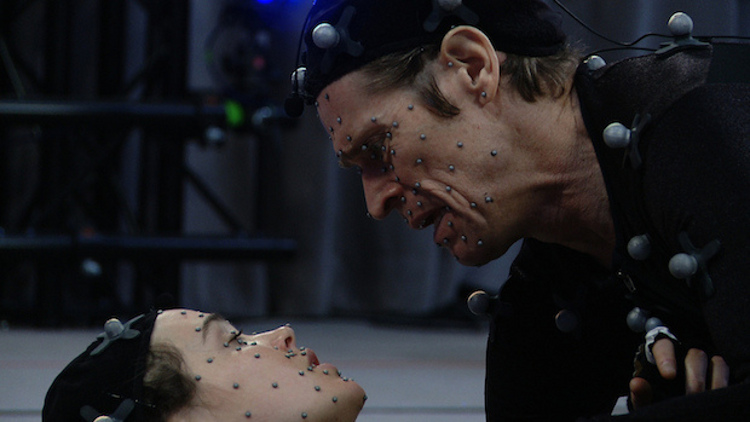
Regardless of how many ping pong balls need to be sacrificed, I hope to see more big names take on the performance capture challenge as much as I’d like to see more digital experiences like Beyond: Two Souls. Video games still harbor old remnants of unsophisticated reputations despite their popularity and evolution. So it’s good to see an intrepid few daringly cross the boundaries between video games and “higher” media with success.

 Gray Areas
Reblogged this on Recollections of Play and commented:
Although I completed Beyond: Two Souls nearly a month ago, it’s consistently been on my mind for a number of reasons, one of which I expounded upon in this #Voluntines post I wrote for one of my favorite sites, At The Buzzer. (Also, FOLLOW THEM! NOW!) There are several things that make BTS unique among today’s games, such as its use of professional actors who not only voiced the main characters but also underwent the fascinating and, I can only imagine, grueling process of performance capture. The results are impressive, if not perfect, and I hope they’re signs of things to come in games.